
“AI Trends to Watch in 2025”

"AI Startups Are Powering the New White-Collar Gig Revolution in 2025"

How AI is Creating High-Paying Gig Opportunities for Professionals in Banking, Law, and Beyond
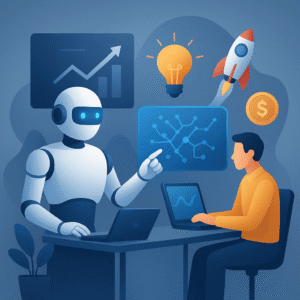
The global workforce is undergoing a quiet revolution as AI startups redefine white-collar work. Companies like By 2025, companies like Turing, Mercor, Surge AI, and Scale AI will be paying highly skilled workers—like bankers, lawyers, doctors, and engineers—hundreds of dollars an hour to train AI models on difficult professional tasks.

and other platforms are at the center of the change, offering professionals like private investigators, medical secretaries, and filmmakers flexible work schedules. The cost of AI training can range from $20 to $185 per hour for part-time employment to up to $200,000 per year for full-time employment.

For specialized advice, Surge AI has paid venture capitalists and startup founders up to $1,000 per hour. According to reports, Mercor pays experts like OpenAI and Anthropic $1.5 million every day to support its clients.

These kinds of contracts, which range from banking and advertising operations to legal analytics, have proliferated throughout Indian cities, particularly Bengaluru, Hyderabad, and Pune. Bloomberg and The Economic Times claim that OpenAI’s covert “Mercury” project pays former bankers $150 per hour to teach its AI systems financial modeling, among other things like mergers and acquisitions. By enabling remote contributions through knowledgeable analysts, Hebbia AI is utilizing its platform to transform the investment workflow.

0:00 / 0:00

"NVIDIA: Powering the Next Wave of AI and Global Technology"

NVIDIA isn’t just propelling the future of AI—but redefining the laws of computing, where machine-driven human language and worldwide innovation and ethical leadership collide.

NVIDIA, famously known for the dominance of its GPUs, is spearheading the world’s AI revolution. In the recent London Tech Week, its CEO Jensen Huang announced the new programming language is now set to become “human,” i.e., the future when the AI systems and the advanced technology can be governed by the natural discourse and become ubiquitous. At their center are AI factories—next-gen data centers that take everything from ingestion of the data all the way to deployment in their stride, and making the entire AI lifecycle more efficient. Its hardware roadmap no less ambitious: the Blackwell Ultra (2025), the Vera Rubin (2026), the Rubin Ultra (2027), and the Feynman (2028), each stretching the limits of generative AI performance and energy efficiency.

NVIDIA is expanding worldwide with signature collaborations. In Germany, it’s together constructing a mammoth AI gigafactory with Deutsche Telekom and Brookfield. In Europe, its Jupiter supercomputer powered by GH200 Grace Hopper chips is the fastest and greenest.On policy, NVIDIA resists so-called GPU “kill switches,” in the tradition of preventing mistrust in U.S. technology. Huang also pushed export licenses in China, even with security debates.

In addition to infrastructure, NVIDIA invests in AI for social good. Its Parabricks platform accelerates genomic science, aiding healthcare innovations. Through innovation, ethics, and worldwide scope, NVIDIA is redefining the world’s building, learning, and connecting through the power of AI.

0:00 / 0:00

Leave a Comment

Your email address will not be published. Required fields are marked *